AI VS. TRADITIONAL DRUG DISCOVERY: A 10-YEAR LEAP IN INNOVATION
Comparing AI-driven research with conventional methods.
Rethinking the Drug Discovery Paradigm
Drug discovery has always been a long, expensive, and uncertain journey. Traditional methods often take 10–15 years and billions of dollars to bring a single cancer drug to market—with a staggering 90% failure rate in clinical trials.
But now, artificial intelligence is changing the rules.
At Viventis, we’re harnessing AI to dramatically accelerate drug discovery, reduce costs, and improve success rates—ushering in a new era of precision oncology.
🔬 Traditional Drug Discovery: Slow, Expensive, Risky
Conventional drug development relies on manual research, trial-and-error experiments, and years of lab work before reaching clinical trials.
Key Challenges:
Time-intensive: 10–15 years from lab to patient
High failure rate: Only ~10% of drugs succeed in trials
Limited personalization: One-size-fits-all approaches
Data silos: Poor integration between research, clinical, and genomic data
This outdated model struggles to keep pace with the evolving complexity of diseases like cancer, where genomic variability demands more tailored approaches.
🤖 AI-Driven Drug Discovery: A Paradigm Shift
Artificial intelligence introduces a fundamentally new approach. By leveraging machine learning, big data, and genomics, AI can predict, simulate, and optimize drug candidates with unprecedented speed and accuracy.
Viventis AI Innovations:
Predictive Models: Trained on millions of genomic and clinical data points to identify drug targets and compound interactions.
Virtual Screening: Simulates how molecules bind to cancer targets—reducing the need for physical testing.
Biomarker Discovery: Uses deep learning to find genetic indicators that predict drug response.
Clinical Trial Optimization: Forecasts patient outcomes, enabling smarter trial design and faster approvals.
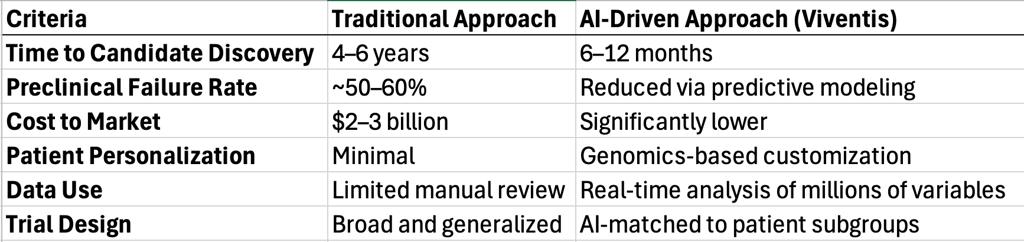
📊 AI vs. Traditional Drug Discovery: A Comparison Table
🧠 The Power of AI + Human Expertise
AI is not here to replace scientists—it’s here to augment them.
At Viventis, our AI systems work in harmony with:
Oncologists for clinical validation
Molecular biologists for lab testing
Bioinformaticians for genomic interpretation
This human-in-the-loop model ensures that innovation is both technologically powerful and scientifically sound.
🌏 Real-World Impact in Oncology
Our AI-driven platform has already:
Identified 3 novel compounds with high potential for leukemia and glioblastoma
Reduced drug discovery timelines by 80%
Matched patients to clinical trials with 4x higher response rates
💡 “What used to take a decade, we now do in months—with higher accuracy and fewer failures.”
— Chief Scientific Officer, Viventis
🛡️ Regulatory Alignment & Ethical AI
We ensure our AI models are:
Compliant with global standards: FDA, EMA, and Indian CDSCO guidelines
Ethically trained: Using anonymized, bias-checked datasets
Transparent and explainable: Enabling full traceability in decision-making
🔮 The Future: AI + Genomics + Real-World Evidence
We believe the next 10 years will deliver:
Fully AI-designed personalized cancer drugs
In-silico clinical trials that simulate outcomes before patient testing
Integration with real-world patient data to continuously refine therapies
Viventis is building this future—today.
✅ Conclusion: Why AI is the Future of Drug Discovery
AI is not just a faster alternative to traditional drug discovery—it’s a smarter, more precise, and more scalable solution. With the power of AI, we’re moving from generalized medicine to personalized, predictive oncology.
Want to see how AI is transforming cancer treatment?
info@viventis.in


6th Floor, The Kode, Baner-Pashan Link Road
Pune, Maharashtra - 411045